
An interpretive look at ancient rivalries, modern warfare, and the angelic drama unfolding in our time
"I will make Jerusalem a cup of trembling unto all the people round about." — Zechariah 12:2
A war that never really ended
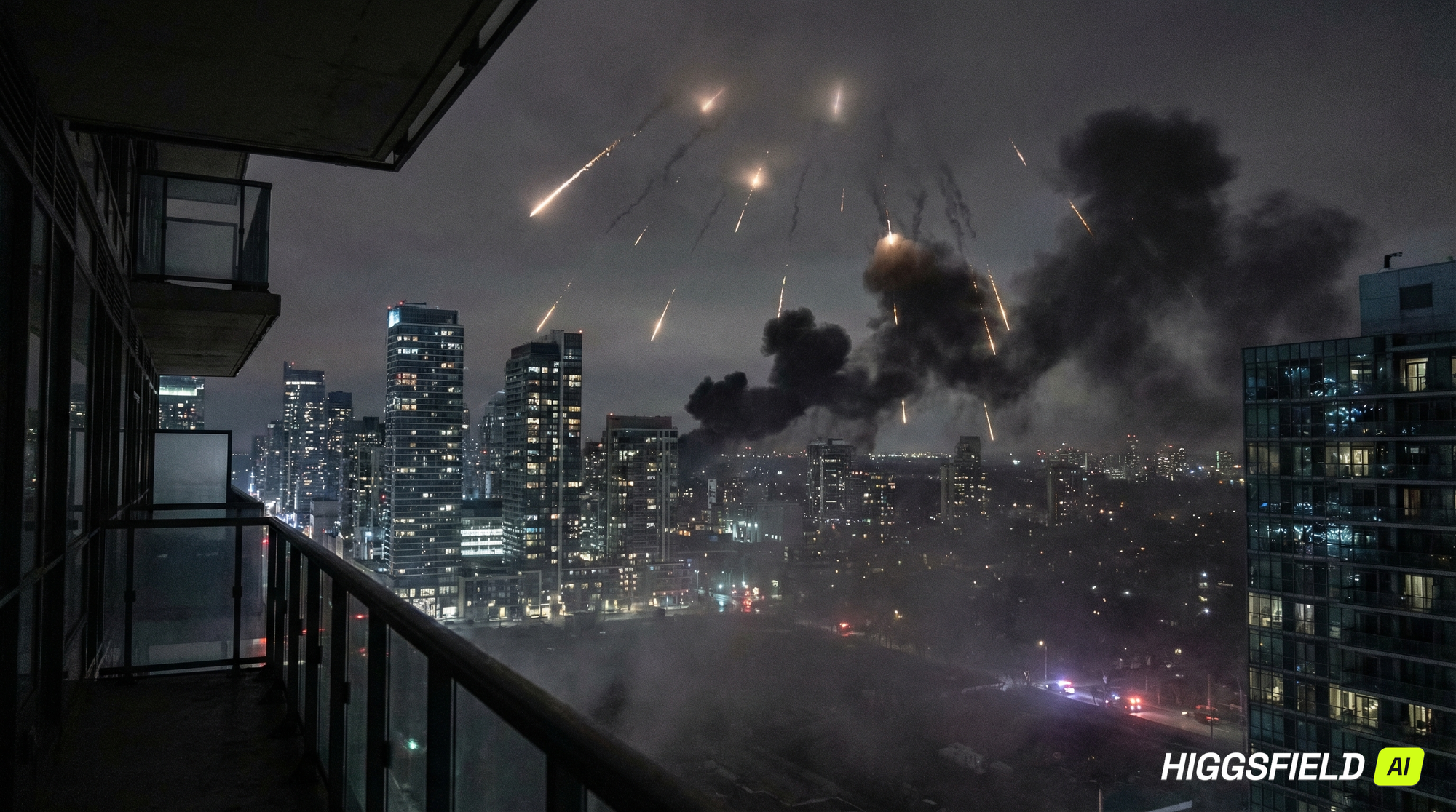
When Hamas militants breached the Gaza border on October 7, 2023, the world watched in horror as 1,195 people were killed — including 364 civilians at the Nova music festival — in what became the deadliest terrorist attack in Israeli history. Israel retaliated with airstrikes on Gaza. Hezbollah launched rockets from Lebanon. The Houthis attacked international shipping from Yemen. Iran launched ballistic missiles directly at Israel. And by February 2026, the United States launched Operation Epic Fury — a direct military campaign aimed at permanently dismantling Iran's nuclear and military capabilities.
To most observers, this looks like a series of modern geopolitical crises cascading into one another. But to those who read history through the lens of Scripture, something older and deeper is unfolding — a conflict whose roots stretch not to 1948, not to the founding of Islam in the 7th century, not even to the Roman destruction of Jerusalem in 70 AD — but all the way back to two brothers born to one man named Abraham.
This is the story of that conflict. And it is far from over.
Part One: The oldest war — Isaac and Ishmael
Every complex story has a simple beginning. The Middle East conflict begins with a family dispute.
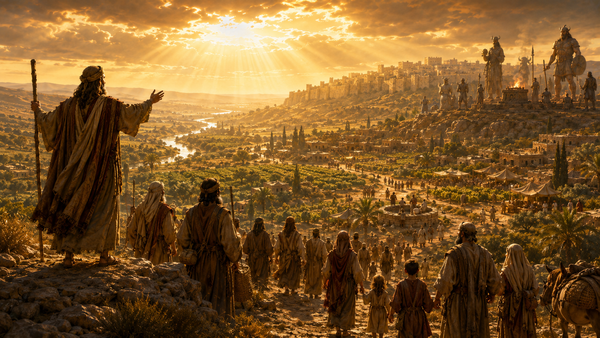
Abraham, the patriarch of three world religions, had two sons. Isaac — born to his wife Sarah — carried the covenant God established with Abraham. Through Isaac came Jacob, then the twelve tribes of Israel, then King David, then ultimately Jesus Christ. Ishmael — born to Hagar, Sarah's servant — was also blessed by God, promised to become the father of twelve princes and a great nation. But the covenant passed through Isaac, not Ishmael.
Arab peoples trace their lineage to Ishmael. The Prophet Muhammad himself descended from an Arab tribe with roots in that Ishmaelite line. And when Islam emerged in the 7th century with a theology that repositioned Ishmael — not Isaac — as the son Abraham nearly sacrificed, it was in many ways the ancient rivalry asserting itself in a new theological form.
This is not merely ancient history. It is the spiritual DNA of a conflict that has never been fully resolved.
Part Two: The land everyone wants
The Middle East is arguably the oldest continuously contested territory on earth. Long before Islam, long before Christianity, long before Israel existed as a nation — empires were killing each other over this land. Babylonians, Persians, Greeks, Romans — all swept through the same corridors, all planted their flags over the same hills, all eventually fell.
Why? Because this land sits at the intersection of three continents — Africa, Asia, and Europe. Whoever controls it controls the ancient trade routes. Whoever holds Jerusalem holds something that billions of people across three religions consider sacred.
Jerusalem has been conquered and reconquered over forty times in recorded history. No other city on earth comes close. When Zechariah wrote in 520 BC that Jerusalem would become a "cup of trembling" for all nations — a burdensome stone that all who lift it would be cut to pieces — he was describing something that has been continuously true for two and a half millennia and remains true today.
Part Three: How the modern conflict was built
The Middle East we know today was not built by its own people. It was built by European powers who had just won a World War and needed to divide the spoils.
The 1916 Sykes-Picot Agreement between Britain and France drew lines across the map with breathtaking disregard for who actually lived there — which tribes, which sects, which ancient communities had shared or contested which valleys for centuries. The result was artificial nations containing deeply incompatible groups forced into political union. Iraq. Syria. Lebanon. Jordan. Lines on a map that became fault lines in human civilization.
Into this already unstable architecture came 1948 — the birth of modern Israel following the Holocaust and the 1947 UN Partition Plan. Arab nations immediately went to war. Israel survived. But the Palestinian displacement — what Arabs call the Nakba, the catastrophe — became an open wound that never healed.
Then came 1967. In six days, Israel captured the West Bank, Gaza, the Sinai Peninsula, and the Golan Heights. Most significantly — Israel captured Jerusalem for the first time since 70 AD. For many Christians, that moment carried profound prophetic weight. For Arabs and Palestinians, it deepened a humiliation that continues to fuel conflict today.
Part Four: The Iranian Revolution — when the script changed
Until 1979, Iran and Israel had warm diplomatic relations. The Shah of Iran maintained ties with the West and recognized Israel as a regional partner. Then the Islamic Revolution changed everything.
When Ayatollah Khomeini took power, opposing Israel became a core pillar of the new Iranian state ideology. Iran immediately severed diplomatic ties with Israel and began building what would become its most powerful strategic asset — not nuclear weapons, not conventional armies — but a network of proxy forces stretching across the region.
Hezbollah in Lebanon. Hamas in Gaza. Shiite militias in Iraq. The Houthis in Yemen. Each armed, trained, and funded by Iran's Islamic Revolutionary Guard Corps. Each positioned to attack Israel from a different direction simultaneously. The strategic logic was elegant and brutal — force Israel to fight on multiple fronts while Iran developed its nuclear program safely in the background.
For forty years this architecture was built slowly and patiently. October 7, 2023 was not a spontaneous uprising. It was the activation of a system decades in the making.
Part Five: 9/11 and the unintended gift to Iran
Here is one of the great tragic ironies of modern history. The September 11, 2001 attacks were carried out by al-Qaeda — a Sunni militant organization that despised both the United States and Israel. Al-Qaeda and Iran are ideological rivals. They share nothing except enemies.
Yet the American response to 9/11 gave Iran the greatest strategic gift it ever received.
When the United States removed the Taliban from Afghanistan in 2001, it eliminated Iran's most dangerous enemy on its eastern border. When America invaded Iraq in 2003 and removed Saddam Hussein, it eliminated Iran's most dangerous enemy on its western border. The power vacuum left by two destabilized neighbors allowed Iran to expand its influence dramatically — installing friendly Shia governments, embedding proxy militias, extending its reach toward the Mediterranean.
The Saudis warned President Bush before the Iraq invasion that removing Saddam would only benefit Iran. They were right. The road from September 11, 2001 to Operation Epic Fury in 2026 runs directly through that miscalculation.
Part Six: Angels, worship, and the invisible war
No reading of the Middle East through a biblical lens is complete without acknowledging what Scripture insists is the deepest reality — that behind every geopolitical conflict is a spiritual one.
Daniel 10 is one of the most startling passages in the Bible. An angel appears to Daniel and explains that he was delayed twenty-one days because the "prince of Persia" — a demonic being — resisted him until Michael, Israel's angelic guardian, came to help. Ancient Persia is modern Iran. The spiritual warfare described in Daniel 10 maps with remarkable precision onto the nation at the center of today's conflict.
The book of Revelation tells us this invisible war has a timeline. Seven seal judgments. Seven trumpet judgments. Seven bowl judgments — all administered by angels. A war in heaven where Michael and his angels expel Satan permanently. The Euphrates River — flowing through Iraq and Syria — appears twice in Revelation's end times sequence as a geographic marker of final judgment.
Worship, throughout Scripture, is not merely devotional. King Jehoshaphat sent singers ahead of his army and the enemy destroyed itself. The walls of Jericho fell to a worship procession. Paul and Silas sang in prison and an earthquake broke their chains. The book of Revelation begins with billions of angels worshipping before judgment is released — worship always precedes the acts of God in human history.
Part seven: Gabriel, Islam, and the question that cannot be avoided
Gabriel — whose name means "God is my strength" — is the most prominent named angel in Scripture. He appeared to Daniel to explain the Seventy Weeks prophecy predicting the precise timing of the Messiah's coming. He appeared to Zechariah to announce John the Baptist's birth. He appeared to Mary to announce the conception of Jesus. Every biblical appearance of Gabriel points unambiguously toward Jesus as the Son of God.
Islam was founded when Muhammad claimed to receive revelations from the Angel Gabriel — revelations that explicitly denied the Trinity, denied the divinity of Jesus, and denied the crucifixion and resurrection. The theological problem is not the word "Allah" — that is simply Arabic for God, used by Arab Christians for centuries and present in the Arabic Bible. The problem is that the message Muhammad attributed to Gabriel directly contradicts everything the biblical Gabriel consistently proclaimed.
Paul anticipated this possibility in Galatians 1:8 — warning that even if an angel from heaven preached a different gospel, that message should be rejected. From a Christian perspective, this is the most serious theological question surrounding Islam's founding — not hostility toward Muslim people, the vast majority of whom are peaceful and made in God's image — but the irreconcilable contradiction at the heart of the revelation claim.
Part Eight: What Revelation says about where this ends
The book of Revelation contains more angelic activity than any other book in Scripture — 67 of the 175 New Testament uses of the Greek word for angel appear in Revelation alone. These are not decorative figures. They are active agents of history's conclusion.
The sequence is clear. Judgment is restrained, then released. War breaks out in heaven and Satan is expelled to earth with great fury because he knows his time is short. Three angels preach the eternal gospel to the whole earth. The Euphrates dries up and the kings of the east march toward Armageddon. Christ returns with the armies of heaven. A single angel binds Satan with a chain and casts him into the abyss. The New Jerusalem descends with twelve angels guarding its gates.
Whether Operation Epic Fury and the current Iran-Israel conflict represent the beginning of this sequence, a foreshadowing of it, or simply one chapter in a longer story — no honest theologian can say with certainty. What can be said is that the geography of Revelation's end times drama — Israel, the Euphrates, Babylon, the kings of the east — matches the geography of today's headlines with a precision that is difficult to dismiss.
Reading the news as if the Bible is TRUE
The Middle East conflict did not begin with Hamas. It did not begin with the founding of Israel in 1948. It did not begin with Muhammad in the 7th century. It began with two brothers, a promised land, and a covenant that one line inherited and another did not.
What we are watching unfold across our screens — the October 7 attacks, the Gaza war, the Iran-Israel exchanges, Operation Epic Fury — is not a modern political crisis that happens to have religious dimensions. It is a theological drama that happens to be playing out on the political stage.
For the believer, the right response is not fear. Revelation's angels worship before they act, and they worship while they act. The church's calling in this moment is the same as it has always been — to worship with abandon, to intercede with urgency, to love Muslims as people for whom Christ died, and to understand the times with the clarity that only Scripture can provide.
The story is ancient. The conclusion is certain. And the God who set Gabriel as His messenger across thousands of years of history has not lost the thread.
This article is a work of interpretive journalism — analyzing current geopolitical events through the framework of biblical theology and prophecy. It represents a Christian perspective and is intended to invite thoughtful engagement with Scripture in light of current events.