
You know that feeling when you're scrolling through your feed and you do a double-take? "Wait, was that real, or...?" Because Google has just unveiled Veo 3, and it's fundamentally changing what's possible with AI-generated video.
We've all seen AI-generated images get incredibly good, but video has always been the holy grail – a much more complex beast. Maintaining consistency, realistic motion, and believable lighting across frames is a monumental challenge. Yet, with Veo 3, Google isn't just taking baby steps; they've launched a full-blown leap forward.


What makes Veo 3 so jaw-droppingly realistic?
- Unprecedented Fidelity and Coherence: Forget the glitchy, inconsistent AI videos of the past. Veo 3 generates high-quality clips that boast remarkable visual fidelity, maintaining character identity, object persistence, and environmental details seamlessly. This means less "uncanny valley" and more "wait, did someone actually film that?"
- Native Audio Generation (Yes, with Dialogue!): This is a game-changer. Unlike many previous models that produced silent visuals, Veo 3 can generate synchronized dialogue, ambient soundscapes, and even background music that perfectly complements the on-screen action. Imagine prompting a scene of a busy market in Divisoria, and Veo 3 not only creates the visuals but also the sounds of vendors, chatter, and jeepney horns – all organically woven in.
- Sophisticated Grasp of Physics and Movement: From flowing water to subtle character movements, Veo 3 demonstrates an advanced understanding of real-world physics. Objects behave realistically, and interactions with the environment feel natural, adding another layer of authenticity to the generated content.
- Enhanced Creative Control: It's not just about what the AI can dream up. Veo 3, especially when integrated with tools like Google's Flow, offers creators a remarkable degree of control. You can specify camera angles, movements, shot types, and even integrate your own assets like logos or specific voiceovers. This level of precision empowers filmmakers and storytellers to craft their vision with unprecedented accuracy.
- From Text to Cinematic Scenes: Veo 3 is a true text-to-video powerhouse. You can simply describe a scene, character, or action in natural language, and the model harnesses its vast understanding to render high-quality, often photorealistic, video clips. This opens doors for rapid prototyping, generating visual assets for social media, or even creating short films with complex sequences that would otherwise require significant resources.
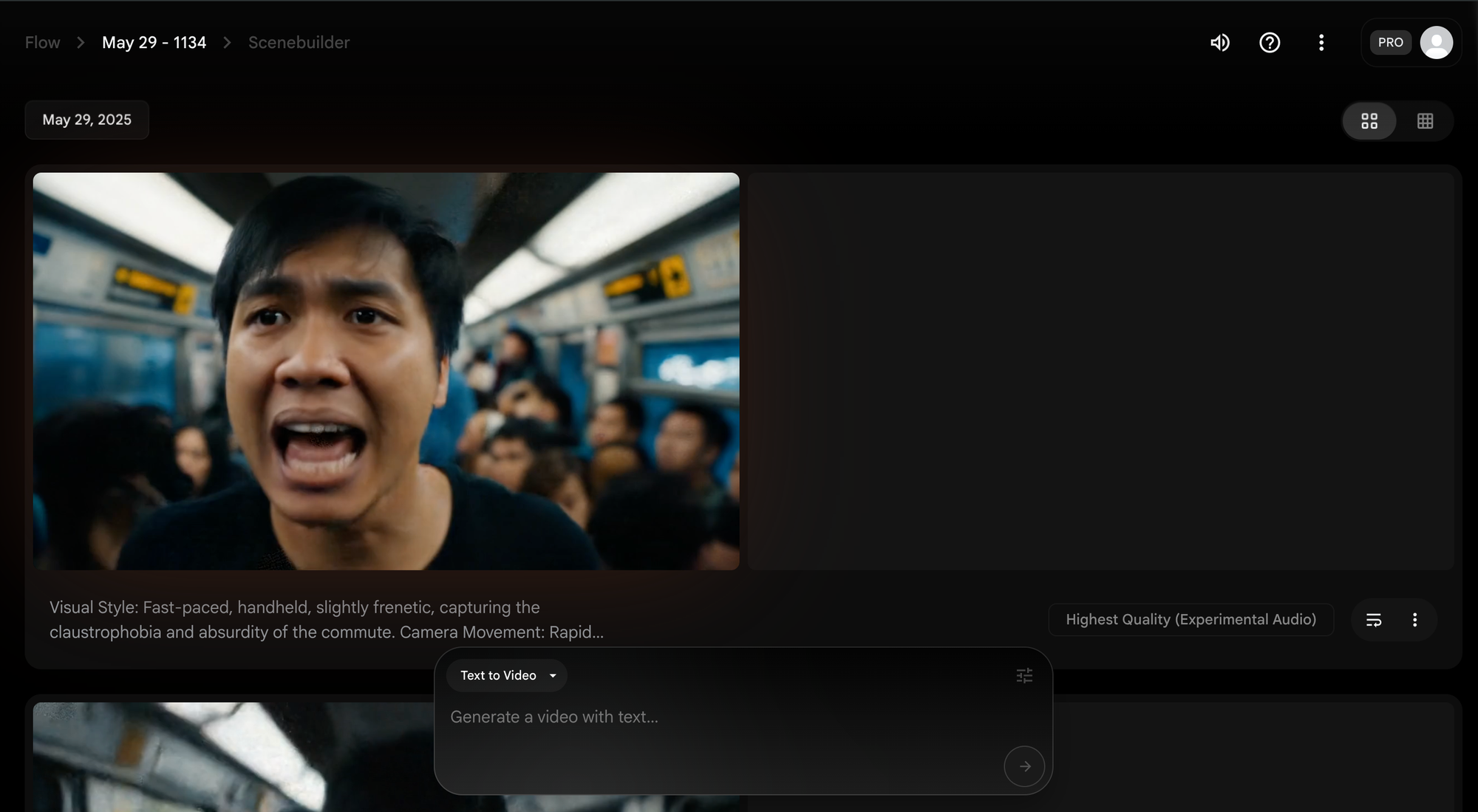
Short clip generated by Google Veo 3
Prompt
Visual Style: Fast-paced, handheld, slightly frenetic, capturing the claustrophobia and absurdity of the commute.

Camera Movement: Rapid cuts between tight close-ups of faces, quick pans, and a few slightly wider shots to show the sardine-can packed train.

Lighting: Harsh

Characters:

DANNY: Mid-30s Filipino, expressive, ranting.
JAKE: Late 20s Filipino, initially zoned out, then panicking.
Setting: A severely overcrowded MRT-3 train car during rush hour. Overlapping train noises and muffled announcements.

Scene: Two friends, Danny and Jake, are crammed into a packed MRT-3. Danny is mid-rant about his toxic job, completely oblivious as Jake's face suddenly contorts in panic, realizing he's lost his phone.

Script:
[SCENE START]

INT. MRT-3 TRAIN - DAY (0-8 seconds)

The train is jammed. DANNY (30s) is loudly gesticulating, almost hitting a commuter. JAKE (20s) is pressed against the door, headphones on, trying to ignore him.

DANNY

(Loud, exasperated)
Commuting in Manila is hell!

Jake's eyes snap open. He frantically pats his pockets, then his bag. His face drains of color.

JAKE

(Muffled, rising panic)
Oh, no... My phone! Danny, my phone! Pick pocket!

Danny stops mid-sentence, looking blankly at Jake.

DANNY

Hey Siri, find his phone!

Jake points desperately at the floor as the train jolts.

[SCENE END]
While currently accessible primarily to Google AI Ultra subscribers and enterprise users via Vertex AI, the implications of Veo 3 are profound. It's democratizing advanced generative AI, making cinematic-quality content creation more accessible than ever before. For content creators, marketers, educators, and anyone with a story to tell, Veo 3 is poised to become an invaluable tool.
The scene I showed earlier, with Danny ranting about the Manila commute and Jake losing his phone on the train, is just a tiny glimpse of what's possible. As this technology continues to evolve, the line between imagination and reality in video creation will become increasingly blurred, and that's an incredibly exciting (and perhaps a little unsettling) prospect!
What are your thoughts on Google Veo 3? How do you see this technology impacting content creation?